CategoriesMedium and Techniques
Passage
A way of painting in which contours open and adjacent planes merge into linked patches of colour, developed above all by Paul Cézanne.
954 works · 10 related artists
About
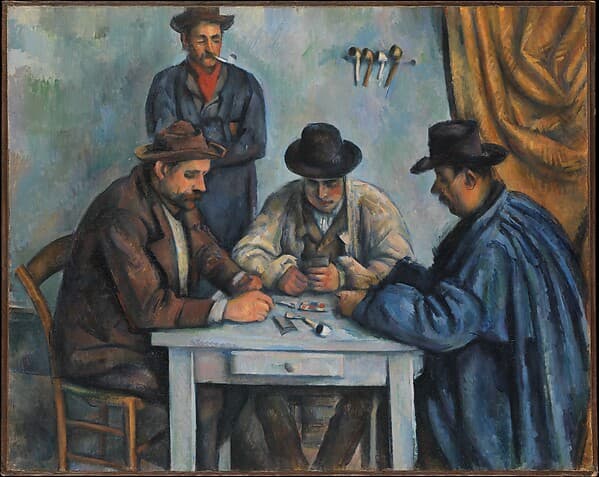
Passage names the places in a painting where an outline gives way and one plane slides into the next instead of being closed off. The French word, meaning a transition or way through, is kept in English writing about art. Paul Cézanne made it a system from the late 1870s: in his views of Mont Sainte-Victoire, blocks of green, ochre and violet strokes cross the borders of trees, fields and houses, so the landscape holds together as one surface while still suggesting depth.
Georges Braque and Pablo Picasso pushed the idea further in Analytic Cubism around 1908–11, when the faceted planes of bottles, instruments and faces leak into surrounding space, as in Braque's Violin and Candlestick (1910). Lyonel Feininger adapted the overlapping planes to churches and seascapes. Look for a contour that stops short, a background colour that spills across an object, or two planes sharing a single stroke.
Related artists
More in Medium and Techniques

Pastel
Performance Art
Photogram
Photograph as Material
Photographic Source
Photographs of Surfaces
Photography
Photojournalism
Photomontage
Photorealistic
Picassoesque
Polychrome Sculpture