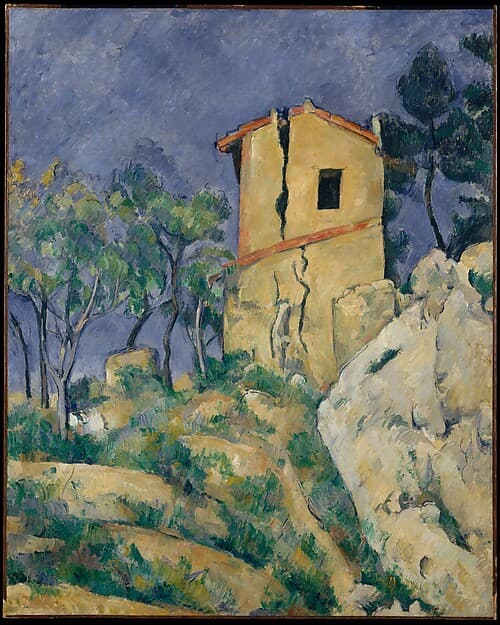
Angular
Art and design dominated by sharp corners, acute angles and pointed, splintering shapes.
No works indexed yet · 10 related artists
No open-access works for Angular are in the index yet. They will appear here as more collections are indexed.
About
Angles carry tension. Where a curve suggests ease, a sharp corner reads as energy, conflict or speed, and artists have used that effect for centuries, from the crisp, broken drapery folds of late Gothic sculpture to the jagged rocks of early Netherlandish landscape backgrounds.
Angularity became a language of its own in the 1910s. Cubists cut objects into facets, the British Vorticists and David Bomberg in The Mud Bath (1914) used shards of form to suggest the machine age, and Ernst Ludwig Kirchner's Berlin street scenes of 1913–15 stretch figures into nervous, pointed silhouettes. Russian Constructivists turned the diagonal into a political signal. In architecture the idea returned with Deconstructivism: Daniel Libeskind's Jewish Museum Berlin, opened in 2001, zigzags in plan and is slashed with slanted windows. Look for acute rather than right angles; a grid of squares is geometric, but not angular.
Related artists
More in Visual Qualities
Asymmetrical
Balance
Biomorphic
.png%3Fwidth%3D960&w=3840&q=75)
Black and White
Blown-Off-Roof Perspective
Blurred
Bright and Vivid Colors
Bulbous
Calligraphic
Color Gradient
Columns and Totems
Contour Line